
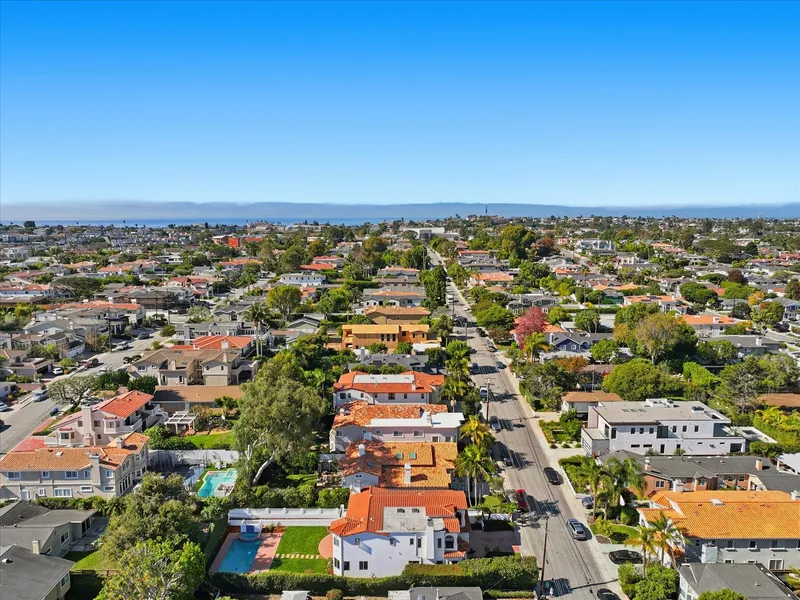
Manhattan Beach has historically had almost no new housing construction. The city is 3.9 square miles, fully built out, and the supply constraint is part of what makes real estate here so valuable. That picture is beginning to change — in a specific and concentrated way.
Here’s what’s happening, why, and what it actually means for buyers, homeowners, and investors.
The Residential Overlay District: Why This Is Happening
In March 2023, the Manhattan Beach City Council adopted the Residential Overlay District (ROD) through Ordinance No. 23-0006. The ROD was a required step to gain state certification of Manhattan Beach’s Housing Element — the state-mandated plan every California city must have for adding housing.
The ROD allows qualifying multifamily residential and mixed-use projects to be built on designated commercial properties by-right — meaning no public hearing, no discretionary review. If a proposed project meets code requirements, the city is legally obligated to approve it.
The 20% affordable housing requirement triggers this by-right approval. Under California’s Density Bonus Law, qualifying projects can also request waivers from local development standards, including height limits and open space requirements.
Where the ROD Applies
The ROD sites are concentrated on commercial corridors — not residential neighborhoods. The primary locations:
- Sepulveda Boulevard (the main commercial spine running through Manhattan Beach)
- Rosecrans Avenue
- Artesia Boulevard
- Aviation Boulevard
The Sand Section, Tree Section, Hill Section, and East Manhattan Beach residential neighborhoods are not part of the ROD. This is important context: the new construction wave is happening on commercial properties, not in the neighborhoods where most single-family homes are.
Active and Proposed ROD Projects
Several projects are already in the pipeline. Here’s what’s been proposed as of early 2026:
| Location | Units | Height | Notes |
|---|---|---|---|
| 3600 N. Sepulveda (former Fry’s Electronics) | 285 | 10 stories | One of the largest proposed projects |
| 401 Rosecrans (Highrose El Porto / Project Verandas) | 79 (6 affordable) | TBD | Approved Jan 2023 — only project currently under construction |
| 1440 Rosecrans | 582 | TBD | Largest proposed project by unit count |
| 2705 N. Sepulveda | 48 | 18 stories | Tallest proposed project; 18 floors is unusual for Manhattan Beach |
| 2905–2909 N. Sepulveda | 70 | TBD | Mixed-use residential and commercial |
| 2301 N. Sepulveda | 38 | 7 stories (75 ft) | 8 low-income, 3 moderate, 27 market rate |
| 201–207 N. Sepulveda (former Deep Roots garden center) | 60 | 7 stories | 69,000 sq ft building |
| 250–400 N. Sepulveda | 111 | TBD | Sunrise Senior Assisted Living proposal |
In total, the ROD sites along Sepulveda and Rosecrans could accommodate over 1,000 new units. Community opposition has been vocal and sustained, but the city’s ability to block qualifying projects is legally limited under state housing law.
What This Means for Manhattan Beach Real Estate
For buyers in residential neighborhoods
The short answer: limited direct impact. The ROD applies to commercial sites on the main commercial corridors, not to residential streets. A buyer purchasing a home in the Sand Section, Tree Section, Hill Section, or East MB is not buying near a 10-story apartment building. The commercial corridors (Sepulveda in particular) have always been commercial — they’re not adjacent to most residential areas in the parts of the city where single-family buyers are looking.
For buyers near Sepulveda
Properties in close proximity to active ROD development sites should be evaluated with that context in mind. Increased density on Sepulveda will bring more residents, more traffic, and a different character to those blocks over time. For some buyers, access to more retail and walkability is a positive. For others, the change in character matters.
For the overall market
Manhattan Beach’s core appreciation story — supply constraint, no new land, fixed inventory — remains intact in the residential neighborhoods. Adding 1,000+ apartment units on commercial parcels doesn’t change the fact that there are still only ~14,000 total housing units in the city and demand for ownership consistently exceeds supply. What it does do is add rental inventory, which may marginally affect rental rates on the commercial corridors over time.
For investors
The ROD itself doesn’t create direct investment opportunities for individual buyers (these are large multifamily development projects), but it’s useful context. If you’re evaluating a property on or near Sepulveda, knowing what’s in the pipeline at adjacent sites is part of basic due diligence.
Community Response
Manhattan Beach residents have been strongly opposed to the high-rise projects, with community meetings drawing heated responses and petitions circulating. The city has been transparent that its options are limited — state housing law requires ministerial approval for projects that meet code requirements, and the city cannot reject qualifying projects without legal exposure.
The city has focused on what it can control. In September 2025, the Council passed Ordinance 25-0008, which added meaningful new requirements for ROD projects:
- Phase I Environmental Site Assessment — required for all ROD projects before approval
- 12-foot sound barrier (minimum STC rating of 32) along any property line shared with a residential use
- 1,000-foot neighbor notification radius — expanded from the prior standard in December 2025, so more homeowners receive notice of proposed projects nearby
These requirements don’t give the city grounds to deny qualifying projects, but they do create baseline protections for adjacent residents and add time to the approval process for projects that need to commission environmental studies.
The Bottom Line
Manhattan Beach is adding more housing than it has in decades — but it’s concentrated on commercial corridors by state mandate, not in the residential neighborhoods that define the city’s real estate market. For buyers focused on the Sand Section, Tree Section, Hill Section, and East MB, the supply constraint that has driven appreciation remains structurally intact.
Important: Development proposals, project status, and city ordinances change. For the most current information on specific ROD projects or zoning questions, contact Manhattan Beach Planning at (310) 802-5520. This guide is informational — verify details with the city before making decisions based on development pipeline information.
If you’re evaluating a specific property near a ROD site or want to understand what’s proposed at a particular address, I’m happy to walk through it.
Cecilia Agraz | Stroyke Properties Group
310-803-9338 | cecilia@manhattanhermosahomes.com
DRE #01974999
Also reading: Manhattan Beach for Real Estate Investors | Sand Section Neighborhood Guide | ADU Guide for Manhattan Beach

Cecilia Agraz
South Bay neighbor and Realtor® focused on clear guidance and low‑stress moves in Manhattan Beach & Hermosa Beach.