
If you’re reading this, you may already know Manhattan Beach a little — or maybe not at all. Either way, I want to be upfront about what this article is and isn’t.
It’s not a pitch. It’s not an attempt to suggest that Manhattan Beach is a replacement for Pacific Palisades, because it isn’t. The Palisades had a very specific character — the bluffs, the canyon light, the Riviera’s hillside privacy, the Highlands’ separation from the city — that Manhattan Beach doesn’t replicate. For some buyers, that character was the whole point, and the right answer for them is to wait, rebuild, or find the closest equivalent on the Westside.
But I’ve had a number of conversations over the past year with buyers — some directly displaced, some who had been considering the Palisades before January 2026, and some who are simply reconsidering where they want to be — and what I’ve noticed is that a subset of them hadn’t seriously looked at Manhattan Beach before. The commute assumptions were off. The school picture wasn’t clear. The lifestyle felt like an unknown.
So this is for that buyer: someone making a considered decision, who wants honest information rather than a sales narrative.
First: What the Fires Changed
The January 2026 Palisades Fire destroyed more than 6,500 homes in the Pacific Palisades area alone, with the broader LA fires burning over 38,000 acres and damaging or destroying more than 13,000 residential parcels across the region. The scale was unprecedented. More than 74% of displaced Palisades residents remain in temporary housing as of early 2026. Rebuilding is moving slowly — as of March 2026, fewer than 30 structures had been completed across all LA fire zones combined.
For many displaced families, the question isn’t whether to return — many intend to — but what to do in the meantime, and whether the meantime might become permanent. That’s a genuinely hard question, and it deserves a clear-eyed answer rather than pressure in either direction.
What I can offer is a clear picture of what Manhattan Beach actually is — and an honest accounting of where the two communities overlap and where they diverge.
The Similarities That Matter
The comparison between these two communities isn’t accidental. It’s why, within weeks of the fires, a community called “Pali South” had formed in Manhattan Beach — hundreds of displaced families who had relocated here and found the cultural fit close enough to name it.
Both are coastal, affluent, family-oriented communities with strong civic identities. Both have genuine small-town character — the kind of neighborhood where you recognize people at the farmers market, where school sports draw real community turnout, where the feel of the place is shaped by longtime residents rather than transience. Both have excellent public schools. Both are the kind of places where people move once and stay for decades.
The similarity runs deep enough that the two communities had existing connections before the fires — shared private school networks (Loyola High School, in particular), overlapping professional circles, and a mutual understanding of what coastal LA life looks and feels like when you’ve chosen to step back from the industry’s social orbit.
Where They Genuinely Differ
The differences are real and worth understanding clearly.
Topography and Beach Character
Pacific Palisades is built on bluffs and hillsides — the Riviera’s elevated estates, the Highlands’ canyon separation, the bluff-top homes overlooking PCH. The views are long and the privacy is partly topographic. You feel above the city in a way that’s particular to that landscape.
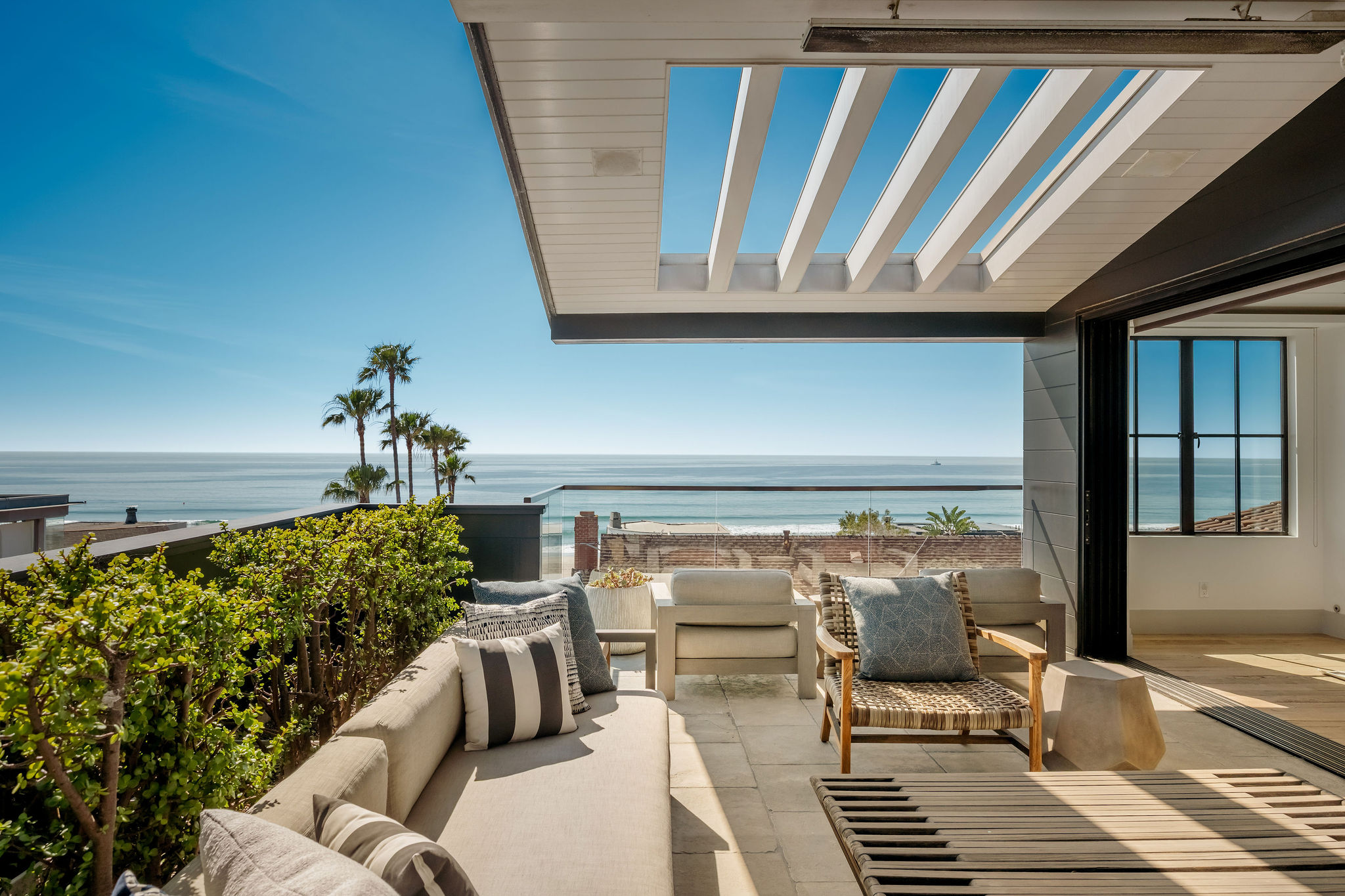
Manhattan Beach is flat. It sits at sea level. The beach is not below you — you walk out the front door and you’re on it. The Strand runs along the waterfront, and the Sand Section’s Walk Streets end at the sand. The Hill Section (the closest MB equivalent to elevated living, with Catalina views and quiet residential streets) offers some elevation, but it’s a different kind of privacy — a quiet residential neighborhood rather than a hillside remove.
Neither is better. They’re genuinely different experiences of coastal living. Which one fits you depends on what you actually valued about the Palisades.
Commute to the Studios and Westside
This is the honest part that many South Bay enthusiasts gloss over, so I won’t.
Pacific Palisades is Westside. Manhattan Beach is South Bay. Those are different commute patterns, and if your daily life is organized around the Westside’s studio corridor, the difference matters.
| Destination | From Pacific Palisades (off-peak) | From Manhattan Beach (off-peak) |
|---|---|---|
| Culver City / Sony Pictures / Netflix | 15–20 min | 20–30 min |
| Century City / CAA / WME | 15–20 min | 25–35 min |
| Hollywood / Sunset Strip | 20–30 min | 35–50 min |
| Warner Bros. / Burbank | 30–45 min | 45–60 min |
| SpaceX (Hawthorne) | 35–50 min | 5–10 min |
| LAX | 20–30 min | 10–15 min |
| Pacific Palisades ↔ Manhattan Beach | ~16 miles, 25–30 min off-peak via PCH / CA-1 | |
If you’re in entertainment and your work is Culver City or Century City — Netflix, Sony, Amazon, the agencies — the commute difference from Manhattan Beach is manageable and many entertainment professionals make it work. If your daily life is Burbank or Hollywood, it’s a longer haul and worth thinking through honestly. If you work in aerospace or at SpaceX in Hawthorne, Manhattan Beach is an obvious upgrade.
LAX proximity is consistently undervalued in this comparison. If your life involves significant travel — and for many Palisades-level professionals it does — being 10–15 minutes from the airport without navigating 405 or 105 from the Westside is a genuine quality-of-life difference.
Schools: Both Excellent, But Different
This is where the comparison gets interesting.
Palisades Charter High School had a strong academic reputation — a 9/10 on GreatSchools, a 95% graduation rate, and a student body that reflected the broader wealth and educational aspirations of the community. For Palisades families, the school was a known quantity and a point of community pride.
Mira Costa High School in Manhattan Beach consistently ranks in the top 1% of California high schools nationally. SchoolDigger places it 119th of 2,162 California public high schools. The entire MBUSD is one of the top-rated unified school districts in the state — all five elementary schools, Manhattan Beach Middle School, and Mira Costa High. MBUSD is a district where the public school option is genuinely elite, not merely acceptable.
It’s also worth noting what happened in the months following the fires. MBUSD absorbed more than 230 emergency transfer students from Pacific Palisades in 2025. The community — schools, sports teams, parent networks — welcomed them. By year-end, many of those families had decided to stay. That’s not a sales point; it’s a data point about fit.
Price: Where Things Actually Stand
Pacific Palisades prices before the fires were comparable to Manhattan Beach at many price points, with the highest-end Riviera and bluff properties running well above the typical MB range. Post-fire, Palisades land values have declined 35–40% as the rebuild market tries to find its footing.
| Property Type | Pacific Palisades (pre-fire, 2024) | Manhattan Beach (2025–2026) |
|---|---|---|
| Median sale price (all residential) | ~$3.5M–$4M | ~$3.3M (record set Dec 2025) |
| Entry-level SFR | $2M–$3M | $2.5M–$3.5M (Tree/Hill Section) |
| Mid-range renovated SFR | $4M–$7M | $4M–$8M |
| High-end / hillside / bluff estates | $8M–$20M+ | $8M–$20M+ (Strand, Hill Section) |
| Oceanfront | Not directly comparable (bluff/PCH frontage) | $12M–$25M+ (The Strand) |
The two markets were broadly similar in price depth before the fires. Manhattan Beach prices have held — the city finished 2025 at a record median of $3.325M, up nearly 10% from the prior year. The fire displacement added demand pressure that the market absorbed without dramatic distortion. For a buyer coming from the Palisades at a $4M–$10M budget, the MB market is a direct overlap.
Community Character: More Similar Than You’d Think
Both communities attract a mix of entertainment industry, finance, technology, and professional families. Both have long-term resident cultures that value privacy without gates and community without pretension. Both are coastal beach towns with strong athletic identities.
The differences are more tonal than structural. Pacific Palisades skewed Westside — its social orbit had more industry connection, its landscape more hillside privacy, its pace slightly more contemplative. Manhattan Beach skews South Bay — more athletic, more beach-centric, more likely to have a volleyball game on the sand or a race finishing at the pier than a dinner party in a canyon canyon home. The MB identity is active, community-visible, and slightly less removed from the city’s outdoor fabric.
Neither is better. They reflect different preferences within the same general lifestyle category. The question is which version actually fits how you live.
What Manhattan Beach Offers That the Palisades Didn’t
A few things worth naming directly:
- Direct beach access. The Sand Section’s Walk Streets end at the sand. The Strand path runs the full length of the city. You don’t drive to the beach — you walk out the back.
- LAX proximity. 10–15 minutes, no freeway. For families that travel frequently, this matters.
- Wildfire risk profile. Manhattan Beach has no significant wildland-urban interface. The city is flat, coastal, and surrounded by other urban neighborhoods. It is not a fire-prone environment in the way the canyon and hillside communities of the Westside are. This is not a hypothetical consideration anymore.
- Supply scarcity. Manhattan Beach is 3.9 square miles — the most constrained coastal real estate market in the South Bay. Inventory is consistently tight. The price floor is durable.
- SpaceX and aerospace access. If your work is Hawthorne, El Segundo, or the broader aerospace cluster, Manhattan Beach is 5–10 minutes away. The Palisades was 40+ minutes.
What the Palisades Offered That Manhattan Beach Doesn’t Replicate
Being honest means naming this too:
- Topographic privacy. The bluff-top and hillside homes of the Riviera and Highlands offered a kind of visual and physical remove that is not available in flat Manhattan Beach. If that separation was the core of what you loved, the Hill Section is the closest approximation — but it’s a different scale and character.
- Canyon and trail access. The Palisades sat adjacent to Topanga State Park and extensive hiking. Manhattan Beach has The Strand and the beach — not hiking trails into open space.
- Westside proximity. If your professional and social life is organized around Beverly Hills, Brentwood, West Hollywood, or the agency corridor — the Westside geography of the Palisades was a genuine advantage that the South Bay doesn’t match.
- The Palisades itself. There’s something specific about a place that’s hard to articulate: the particular light at the Riviera in the afternoon, the village center, the specific community that grew up there over decades. That doesn’t transfer. It was its own thing.
Who Manhattan Beach Is Actually Right For
In my experience, displaced Palisades buyers who end up committing to Manhattan Beach tend to share a few things in common. They’re often families for whom MBUSD is a direct or better fit than Pali Charter. They work in industries with South Bay anchors — aerospace, tech, the medical complex near Torrance, or a role that involves significant LAX travel. They prefer a flat, walkable, beach-at-your-feet lifestyle over an elevated, view-and-privacy lifestyle. And they find, after spending some time here, that the community warmth isn’t an accident — it’s the culture.
If those things resonate, Manhattan Beach is worth a serious look. If they don’t — if the Westside proximity, the topographic privacy, or the canyon lifestyle was central — then waiting for the right Westside opportunity may be the better call, and I’d rather tell you that than sell you something that doesn’t fit.
Frequently Asked Questions
Is Manhattan Beach safe from wildfires?
Manhattan Beach has a very low wildfire risk profile. The city is flat, coastal, and entirely within an urban grid — there is no wildland-urban interface. It is not in a state-designated High Fire Hazard Severity Zone. This is a meaningful distinction for buyers coming from hillside or canyon communities.
How do the schools compare between Pacific Palisades and Manhattan Beach?
Both had excellent public schools. Palisades Charter High School held a 9/10 on GreatSchools with strong academic outcomes. Mira Costa High School ranks in the top 1% of California high schools nationally, and the full MBUSD system — five elementary schools, middle school, and Mira Costa — is consistently rated among the best unified districts in the state. For most families, MBUSD represents an upgrade or a direct equivalent.
What’s the commute from Manhattan Beach to the entertainment industry?
Culver City studios (Netflix, Sony, Amazon) are roughly 20–30 minutes off-peak via Lincoln Boulevard. Century City and the agency corridor run 25–35 minutes. Hollywood and Burbank are longer — 35–55 minutes depending on traffic. If your work is Culver City, the commute is genuinely workable. If it’s Burbank daily, it’s a stretch. LAX is 10–15 minutes — a significant advantage for frequent flyers.
Are Pacific Palisades prices and Manhattan Beach prices comparable?
Broadly yes, at the mid-market. Before the fires, both markets operated in similar price ranges for comparable single-family homes: $3M–$8M for well-located renovated properties, $8M–$20M+ at the high end. Manhattan Beach finished 2025 at a record median of $3.325M. Post-fire, Palisades land values have softened significantly as the rebuild market develops, but pre-fire prices were roughly in the same tier.
What neighborhoods in Manhattan Beach are most similar to Pacific Palisades?
The Hill Section is the closest comparison to the Palisades’ elevated, private character — quieter streets, views, a residential feel that’s removed from the beach activity. The Sand Section’s Walk Streets appeal to buyers who want the highest-privacy coastal living with immediate beach access. The Tree Section is the family-oriented equivalent for buyers with school-age children who want tree-lined streets and proximity to downtown.
If You’re Navigating This Decision
I’m not going to pretend this is an easy moment to be making real estate decisions. You may be in temporary housing. You may be holding a strong intention to return to the Palisades while also knowing the timeline is genuinely uncertain. You may be looking at this from the outside — an entertainment buyer who had been considering the Palisades and is now reconsidering the whole premise.
Whatever the context, I’m happy to be a resource — not to push you toward a decision, but to give you an honest picture of what Manhattan Beach offers, what it doesn’t, and whether it makes sense for your situation. If the answer is that it doesn’t, I’ll tell you that too.
My practice is built on this market. I know it well. And I’d rather have one honest conversation than three optimistic ones.
Cecilia Agraz | Bayside Real Estate Partners / Stroyke Properties Group
310-803-9338 | cecilia@manhattanhermosahomes.com | DRE #01974999
Also reading: Manhattan Beach Sand Section Guide | Hill Section Guide | Tree Section Guide | Moving to Manhattan Beach | Manhattan Beach for Entertainment Industry Professionals

Cecilia Agraz
South Bay neighbor and Realtor® focused on clear guidance and low‑stress moves in Manhattan Beach & Hermosa Beach.