
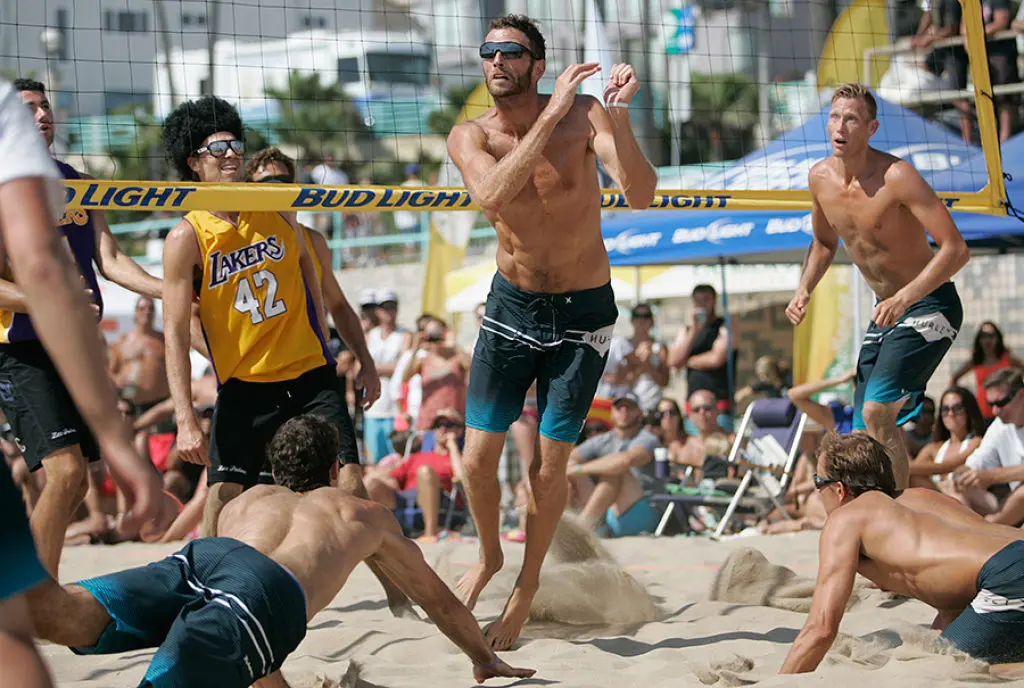
I have competed on the beaches of Manhattan Beach and Hermosa Beach on the AVP tour for years. I still do. So when someone asks me what it’s like to play volleyball here, my answer isn’t from a brochure — it’s from arriving at the courts at dawn before a tournament, warming up with your partner on sand that thousands of players before you have worn smooth, and watching the Pacific turn gold while you run through your serve pattern for the hundredth time.
There’s something this beach does to volleyball players. It pulls them in and doesn’t let go. The conditions are demanding — the wind off the water can shift mid-rally, the sand is deep and unforgiving, the afternoon sun angle will catch you off guard if you haven’t played here. And yet players come from all over the country to train here, because there are few better environments in the country to develop as a player.
As a real estate broker, I also think about what it means to live here. The volleyball courts aren’t an amenity you visit on weekends. They’re part of the fabric of daily life. This article is my honest account of both sides of that coin — the volleyball and what it means for anyone thinking about calling this stretch of coast home.
The Courts: Where to Play in Manhattan Beach
Manhattan Beach has more than 50 public beach volleyball courts running along its coastline, and every single one of them is free. You don’t need a reservation, a permit, or a membership. You show up, find an open court, and play.
The epicenter is the Manhattan Beach Pier area. Courts cluster most densely in the blocks immediately surrounding the pier, and this is where you’ll find the most competitive pickup games on any given afternoon. It’s also where the AVP sets up its tournament infrastructure during the Manhattan Beach Open — more on that in a moment.
Courts spread both north and south from the pier, so wherever you’re coming from on the beach path, you’re never far from a net. If you’re in the Sand Section, you can step outside your front door and be on a court in under five minutes. That’s not hyperbole — I’ve done it.
The furthest north stretch heads into El Porto, the northernmost pocket of Manhattan Beach, where the courts are slightly less crowded and the wind tends to be more consistent. If you want to work on specific shots without the congestion that builds near the pier, it’s a good option.
The Pickup Game Culture
One of the things I love most about playing here is the unwritten social system around pickup games. Courts near the pier typically operate on the winner-stays format — the way beach volleyball has always been played. You put your shoes on the post to claim the next game. If you’re good, you stay. If you’re not, you get run, and that’s fine too. Nobody’s going to be rude about it, but nobody’s going to go easy on you either.
The courts here cover every level — from kids just starting out and recreational players to former college All-Americans and AVP veterans who live a few blocks away. Near the pier on weekend afternoons, the competition is serious: you might be on the net next to a 50-year-old who has been playing this exact court for 30 years. Manhattan Beach has that kind of depth across the board.
Weekday mornings are a different experience — more training-focused, less competitive chaos, good for pairs who want to put in serious work without the weekend crowds. This is when I prefer to train when I’m home between events.
The Manhattan Beach Open: The Tournament That Put Beach Volleyball on the Map
The Manhattan Beach Open is one of the oldest beach volleyball tournaments in the country, and it is widely considered the event that helped establish beach volleyball as a serious competitive sport. The beach itself is widely regarded as the birthplace of the modern game — it grew up here, on this sand, at these courts, over decades of tournament history.
The 2026 AVP Manhattan Beach Open is August 14–16. That’s the one you want to be here for.
Tournament week in Manhattan Beach is unlike anything else in beach sports. The pier area transforms into a proper stadium — the main court goes up right on the sand, the bleachers fill in, and the energy level ratchets up to something that’s hard to describe if you haven’t felt it. The crowd understands volleyball at a level you don’t always find at other sports events. When a blocker gets a stuff block at a critical moment, the fans erupt the way a basketball crowd reacts to a dunk. They know what they’re watching.
If you’re a player at the pro level, this is the tournament. Winning Manhattan Beach means something different than winning anywhere else on the tour. Ask any player which tournament carries the most weight — Manhattan Beach is always on that list.
And if you’re a spectator? General admission along the beach is free. You can plant yourself in the sand and watch the world’s best players from ten feet away. The main stadium seating has a ticket cost, but the beach access around it doesn’t. It’s one of the most authentic sports experiences left in professional athletics — no corporate buffer between you and the action.
Watching from the Strand
For residents, tournament week takes on a particular character. The Strand — the path that runs the length of the beach — takes on a tournament energy during those four days. If you live close enough to the pier area, the whole week has a different feel.
For Strand residents, the tournament essentially arrives at their doorstep. Whether you can actually see matches from your deck depends entirely on your proximity to the main court setup — for most Strand addresses, the view is limited, but you’ll hear the crowd and feel the energy. That access to world-class competition is part of what makes beachfront ownership here genuinely different from beachfront anywhere else.
The Charlie Saikley 6-Man: The Tournament the Whole City Shows Up For
If the Manhattan Beach Open is the tournament players chase, the Charlie Saikley 6-Man is the one the whole community shows up for. It’s been running since 1974 — more than fifty years of teams, costumes, and serious volleyball packed into one weekend on the sand. Charlie Saikley, who started the whole thing, is often called the godfather of beach volleyball. That title is not an exaggeration.
The format is six-player teams, and each team picks a costume theme — a requirement most teams have been honoring for decades, some showing up in the same costumes year after year. There are real competitive divisions: men’s open, women’s open, men’s 40+, men’s 50+, women’s masters. But the spirit of the thing is festive in a way the AVP events aren’t. It’s part of the International Surf Festival and runs over a Friday-Saturday in early August, drawing an estimated 70,000 people across the weekend.
If you’re in Manhattan Beach during the 6-Man, you’ll know it. Every court fills in, and the beach becomes a different place for those two days — louder, more social, fully given over to volleyball and the people who love it.
Hermosa Beach Volleyball: The Same Coastline, More Courts
The volleyball culture doesn’t stop at the city line. Hermosa Beach, just south of Manhattan Beach, has 71 public beach volleyball courts — more courts than any other city on this coastline. The two beaches together form one of the densest concentrations of volleyball infrastructure anywhere in the world.
The Hermosa Beach Pier area is its own hub, with courts running from the pier north to the MB border and south toward Redondo. The style of play in Hermosa skews slightly more open — there are enough courts that you don’t have to fight for space the way you sometimes do on MB tournament weekend. Both beaches see serious players on a daily basis, and serious players tend to float between the two depending on the conditions and who’s around.
If you spend time at the Hermosa courts, you’ll start to notice the informal culture that holds it together. Regulars have favorite courts, and if you’re around long enough, you learn which ones are spoken for at certain times of day. On summer weekend mornings, some locals claim their preferred court early — leaving a ball bag, a chair, or gear on the post — so when the rest of their group arrives, they’re not scrambling up and down several blocks looking for an open net. Nobody’s being territorial in an unfriendly way. It’s just how it works when the same people have been showing up to the same courts for years. Some regulars have even decorated their favorite posts to mark them as their own.
The setup varies court to court, though courts with dedicated regulars tend to be better maintained — nets adjusted, antennae in place, lines set. More advanced players and coaches tend to bring their own antennae to courts that don’t have them. Everyone brings their own ball — serious players usually show up with a whole bag of them — and writes their name on each one, sometimes a phone number too. If you see a ball sitting out on the sand while a group is playing at the far end of the court, it belongs to them. Visitors sometimes assume an unattended ball is fair game. It’s not — and if you want to borrow it, just ask first. The culture here is welcoming, but it has its own rules, and respecting that goes a long way.
The AVP has deep roots in Hermosa. The first AVP Hermosa Beach event was held in 1984 — one year after the AVP was founded — and the tournament ran every year through 2010, then returned in 2017. In 1990, NBC broadcast the AVP Hermosa Beach event on national television, marking the first time beach volleyball had ever appeared on national broadcast TV in the United States. That broadcast is one reason the sport got the exposure it needed to grow into what it is today. The South Bay didn’t just host volleyball — it exported it to the country.
At the pro and competitive training level, Hermosa is generally where more of the serious daily action happens. The combination of more courts and a deep pool of regulars means you can almost always find a high-level game — and many players who compete professionally make Hermosa their primary training beach.
Playing at the Professional Level: What This Beach Means to Serious Players
I played D1 indoor volleyball at Fresno State before transitioning to the beach, and I’ve competed on the AVP and FIVB tours. I’m still competing. So I can give you the honest version of why players come here to train, and why so many of the best players in the country either grew up here or relocated here.
The sand is deep and physically demanding in a way that builds strength and conditioning you can’t replicate indoors. The wind off the ocean — the afternoon onshore breeze especially — forces technical precision. You can’t hide a bad toss in that wind. You can’t get away with lazy footwork when the sand shifts under you on defense. The beach teaches things that gym work and indoor practice can’t.
Beyond the physical environment, the competition density here is unmatched. On any given training day, you can find other pro players, college players competing for spots at top programs, and mid-level serious players who have been developing their games for many years. The level of the people you can play against, any day of the week, is a legitimate reason to want to live here if the sport is part of your life.
There’s also an intangible quality to competing in a place with this much volleyball history. When you’re playing in the same sand where the legends of the sport developed their games, where the AVP was essentially built, it has a certain weight to it. I notice it every time I step onto these courts. That doesn’t go away.
The South Bay has produced or developed some of the most accomplished players in American beach volleyball history, and that’s not coincidence. Holly McPeak — born and raised in Manhattan Beach — is an Olympic medalist, World Championship silver medalist, and Hall of Famer who built her career on these courts. April Ross, one of the most decorated American beach volleyball players of her generation and a three-time Olympic medalist, has competed here throughout her career. The list goes on. The combination of physical environment, competition depth, and cultural investment in the game creates something that’s hard to find anywhere else.
If you want context on where this culture came from — what shaped it and how it got here — Kings of the Beach is a documentary worth watching. Produced by Kevin Cleary, one of the AVP’s founding figures, it follows professional beach volleyball from its roots on the beaches of Southern California through its rise to the Olympics.
What This Means If You’re Buying Here
If volleyball is part of your life — whether you play recreationally on weekends or you’re training seriously — this is the place. The courts are public, they’re free, they’re within walking distance of nearly every property in the Sand Section, and the year-round climate means you’re not waiting for a season. People play here in January. People play here in December. The beach doesn’t close.
For families, there’s a natural pathway: kids can start at any of the recreational courts, get into the beach volleyball culture early, and if they have the drive, find a direct development path to the high school programs at Mira Costa (Manhattan Beach) or Redondo Union and beyond. Two established programs serve the youth pipeline directly. Elite Beach Volleyball is run by Holly McPeak — a Manhattan Beach native and Hall of Famer — and has been developing young players here for years. MBsand (mbsand.com), run by Patty and Mike Dodd, has guided more than 56 players to compete at the Division I collegiate level. Both programs are rooted here because of the volleyball culture that built this community. That’s not common anywhere else.
For serious players — whether active competitors or former college athletes who want to keep playing at a high level — the courts are the reason to be here. I’ve had conversations with players who relocated to the South Bay specifically because they wanted to train in this environment. They don’t regret it.
And for buyers who don’t play at all but value living near world-class sport culture: the tournament weeks in August, the daily energy around the courts, the way volleyball is just woven into the identity of this beach community — it’s a quality-of-life element that’s hard to put a number on. It’s one of the things that makes this place feel alive.
If you want to talk about what life actually looks like on this beach — on and off the court — I’m happy to have that conversation. Reach out anytime.
P.S. I know a lot of coaches here if you’re looking for one.
Frequently Asked Questions: Beach Volleyball in Manhattan Beach
How many volleyball courts are in Manhattan Beach?
Manhattan Beach has more than 50 public beach volleyball courts along its coastline. All of them are free and open to the public — no reservations or fees required. The courts run the full length of the beach, with the heaviest concentration near the Manhattan Beach Pier.
Where are the beach volleyball courts in Manhattan Beach?
Courts run along the beach from El Porto in the north all the way to the city’s southern boundary. The densest cluster is around the Manhattan Beach Pier, which is where the AVP sets up its tournament court during the Manhattan Beach Open. If you’re in the Sand Section, courts are typically a two- to five-minute walk from any address.
Is the Manhattan Beach Open free to watch?
General beach access during the Manhattan Beach Open is free. You can watch matches from the sand, up close, at no cost. The main stadium seating requires a ticket. The 2026 AVP Manhattan Beach Open runs August 14–16.
What level are the pickup games in Manhattan Beach?
The pickup game level near the pier is pretty good, especially on weekends. You’ll find current and former college players, pro tour veterans, and long-time locals who have played this beach for decades. The winner-stays format means competition self-selects — if you’re new or developing your game, weekday mornings or courts farther from the pier are a more approachable starting point — or look into one of the coaching programs that run out of these courts. It’s one of the reasons serious players come here to train.
Is Manhattan Beach or Hermosa Beach better for volleyball?
They’re different, not better or worse. Manhattan Beach has the most iconic history and the biggest annual tournament, with courts clustered near the pier and a high-energy competitive scene. Hermosa Beach has 71 courts — more total than any other city on this stretch — and a slightly more spread-out feel. Both cities have deep AVP roots: the first AVP Hermosa event was in 1984, and the 1990 NBC broadcast of the Hermosa tournament was the first beach volleyball broadcast on national television. Most serious players use both beaches, though at the pro and competitive training level, Hermosa tends to be the daily go-to — more courts, more regulars, and a player base that shows up consistently.
What is the history of beach volleyball in Manhattan Beach?
Manhattan Beach is widely regarded as the birthplace of modern beach volleyball. The two-person competitive format that the world knows today developed largely on these courts, shaped by decades of local players, local tournaments, and a beach culture that treated volleyball as serious sport long before the rest of the country caught on.
The Manhattan Beach Open has been running since 1960 — making it one of the oldest beach volleyball tournaments in the world. Charlie Saikley, who started the 6-Man tournament in 1974 and is known as the godfather of beach volleyball, was a central figure in building the competitive culture here. Sinjin Smith and Randy Stoklos, who dominated the sport in the 1980s and are considered two of the greatest beach volleyball players of all time, both built their legacies on this sand. The AVP was founded in 1983, and the Manhattan Beach Open became one of its signature events. Beach volleyball reached the Olympics in 1996; Karch Kiraly, widely considered the greatest player in the history of the game, won the gold medal in Atlanta — a player whose game was shaped in significant part by time on these courts.
The Hermosa Beach leg of this history is inseparable from Manhattan Beach. In 1990, NBC broadcast the AVP Hermosa Beach Open — the first time beach volleyball appeared on national television. The two cities together form the competitive foundation of American beach volleyball in a way no other place does.

Cecilia Agraz
South Bay neighbor and Realtor® focused on clear guidance and low‑stress moves in Manhattan Beach & Hermosa Beach.