
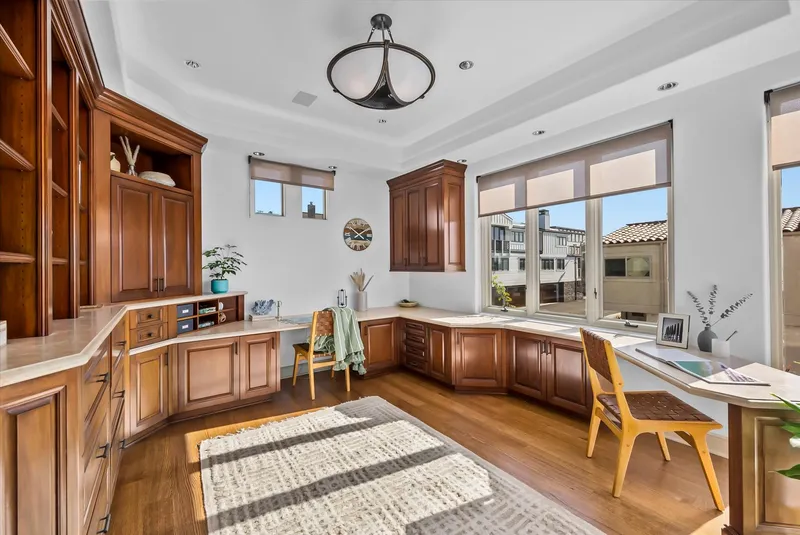
Remote work has created a question that a lot of people are now allowed to ask seriously: if I can work from anywhere, why am I not living somewhere I actually want to live?
For a certain profile of person — high-income, outdoors-oriented, done with paying Manhattan or San Francisco rents for the privilege of commuting to an office — Manhattan Beach is the answer that keeps coming up. This guide is for that person.
I’m Cecilia Agraz, broker with Stroyke Properties Group. I work in Manhattan Beach every day, and I’ve watched the remote worker buyer profile become one of the most consistent segments in this market over the past several years.
What Remote Work Actually Unlocks Here
The math changes when you remove the commute constraint. Manhattan Beach is roughly 25-35 minutes from Century City or Downtown LA — which is fine if you’re going twice a week, and a daily grind if you’re going every day. Remote and hybrid workers have already done this math and made their choice.
What you get in exchange for accepting that distance:
- The Strand as your lunch break. The 22-mile paved coastal path runs from El Porto through Manhattan Beach and into Hermosa Beach. A 30-minute walk during the day — something office workers in SF pay $3,000/month for the theoretical version of — is a literal walk out your back gate.
- Temperature that doesn’t require planning. Low-to-mid 70s most days, year-round. No heat wave protocols. No winter gear. The outdoor environment is the default, not the exception.
- A community that’s actually active during the day. The Tuesday farmers market (11am–3pm on Manhattan Beach Blvd) is full of people. The coffee shops are populated with people working. The beach volleyball courts have players at 10am on a Tuesday. Remote work communities thrive here because the city is built for active daily life, not just weekend activity.
- LAX at 5-8 minutes. Remote workers fly more, not less — to meet clients, attend quarterly offsites, see families spread across the country. The LAX proximity from Manhattan Beach is a real differentiator. No battle through the 405 to catch a 7am flight.
Internet Infrastructure
This matters and it’s worth confirming before you buy. Two primary providers in Manhattan Beach:
- Spectrum (cable internet) — Available citywide. Plans from 300 Mbps to 1 Gbps. Reliable for video calls, large file uploads, and multi-device households.
- AT&T Fiber — Increasingly available in Manhattan Beach; availability varies by address. Fiber is meaningfully faster and more symmetric than cable for upload-heavy work (video production, large file sync, simultaneous calls). Check availability at your specific address.
For households with two working adults, multiple video calls daily, and heavy cloud syncing: check AT&T Fiber availability as part of your home search. It’s not available on every block yet, but it’s worth confirming early rather than after you close.
Backup connectivity: LTE and 5G coverage is strong throughout Manhattan Beach. If your work involves connection redundancy, a cellular backup is reliable here.
What to Look For in a Home Office
Remote workers have specific requirements that casual buyers don’t. Things worth evaluating in every property:
- Dedicated room, not a nook. A separate door matters for focus, noise separation from family, and professional video call backgrounds. “Office-optional” rooms in floor plans are often closets with a desk. Know the difference.
- Natural light without glare. North or east-facing offices are generally better for screen work than west-facing. Afternoon western sun in a home office is beautiful and distracting.
- Soundproofing from shared spaces. In a beach community where kids are home during school breaks and the outdoor lifestyle bleeds indoors, a room that gives you acoustic separation is worth more than the square footage suggests.
- Fiber/ethernet wiring. Newer builds and fully renovated properties generally have structured wiring. Older homes may require a wiring upgrade — worth budgeting for if it matters to your work setup.
- ADU or separate structure. Some properties — particularly in East MB and the Hill Section — have detached garages or ADUs that can be converted to dedicated home office space. If you work with a team, host clients, or simply need full separation from the household, this is worth paying attention to.
The “Moving From SF or NYC” Profile
The most common remote worker buyer in Manhattan Beach is coming from San Francisco or New York. The transition typically looks like this:
In San Francisco, a $3,000-$4,500/month apartment bought proximity to a tech office and to peers in similar situations. The city had culture and restaurants but weather that people tolerate, not enjoy. When the office became optional, the calculus shifted.
A home in Manhattan Beach at $3M-$5M — financed at today’s rates — can have monthly carrying costs comparable to a high San Francisco rent, but you’re building equity, you’re in a world-class school district, and you’re walking to the beach instead of commuting on the 38-Geary.
The New York version is similar, with the added factor that New Yorkers moving to Southern California are often making a genuine lifestyle decision — not just a work optimization. Manhattan Beach gives them a real community and a real downtown without the sprawl that makes most of LA feel isolating.
I’ve written a full guide on this: Moving from SF or NYC to Manhattan Beach.
Co-Working Options (If You Need Them)
Full-time remote workers sometimes need a change of environment — a place to take a call without the dog, meet with a local client, or simply work outside the house. Options near Manhattan Beach:
- WeWork — El Segundo — 10-15 minutes from most MB addresses, with meeting rooms and day-pass options
- Various coffee shops in downtown Manhattan Beach — The walkable downtown area has several that are amenable to laptop workers during weekday mornings
- Manhattan Beach library — quiet, reliable WiFi, free — genuinely underused by remote workers who haven’t discovered it
The Community Factor
Remote workers who move to places purely for scenery often end up lonely. The mistake is optimizing only for climate and square footage without evaluating community density and activity.
Manhattan Beach has community in a way that’s rare for a city of 35,000 people. The Tuesday farmers market, the beach volleyball culture, the school sports events, the downtown area that functions as an actual gathering point — these create organic social connection for people who aren’t going to an office every day. Remote workers consistently describe this as the thing that surprised them most after moving here.
Starting the Conversation
If you’re evaluating Manhattan Beach as your work-from-anywhere base — whether you’re currently in SF, NYC, or somewhere else — I’m happy to talk through the specifics: what your budget gets you, which neighborhoods fit your work setup, and what the realistic timeline looks like.
Cecilia Agraz | Stroyke Properties Group
310-803-9338 | cecilia@manhattanhermosahomes.com
DRE #01974999
Also reading: Moving from SF or NYC to Manhattan Beach | Moving to Manhattan Beach Pillar Guide | New Resident Checklist | Cost of Living in Manhattan Beach

Cecilia Agraz
South Bay neighbor and Realtor® focused on clear guidance and low‑stress moves in Manhattan Beach & Hermosa Beach.